


There are conversations that entertain, conversations that inform, and then there are conversations that rearrange the furniture inside your head. My episode with John Burnett was the third kind.

John is an entrepreneur who has built and operated ventures across Germany, Czech Republic, Ireland, Costa Rica, and the United States. But what drew me to him had nothing to do with his résumé. I first caught him on a panel at Bitcoin Day Naples conference, with him, John Tarantino and Chris Sullivan, and they were doing the thing that very few people in Bitcoin circles are willing to do: trying to wake people up to the full scope of what’s happening, not just the financial piece. I watched it on YouTube and thought, I need to have this man on my show.
What follows are 8 things that stayed with me. It’s like the residue of a great conversation with a good, smart friend that I’m still processing.
1. The financial system is an energy confiscation machine
This reframe hit me hard because of how precisely John articulated it. The financial system was never designed to manage money. It was designed to siphon off human energy and channel it upward into the control structure. Central banking, the fifth plank of the Communist Manifesto was deliberately erected rather than a natural societal evolution. The money printing is the source of the spring. Everything downstream: big tech, technocracy, the medical industrial complex, feeds off it.
Bitcoin’s relevance in this framing is completely different from the price conversation. An absolutely scarce, unseizable form of money is a plug for the hole through which the control structure feeds itself. That’s it. That’s the whole thing. Looking at it as a better retirement account, or focusing only on it’s “number go up” attribute, is missing the point. Bitcoin is a barrier against the siphoning of human energy over time.
2. You are collateral. There’s a CUSIP to prove it.
At birth, the state registers you. A birth certificate is issued. A trust is opened in your all-caps name; not your name, but a legal entity assigned to you. And that entity is bonded and securitized. John knows this from experience: he went through a decade-long commercial legal dispute and, through a contact, was able to look up his own case number in a CUSIP database — the Committee on Uniform Security Identification Procedures numbering system used for bonds and securities. His case was sitting in a large fund, pre-packaged and pre-determined.
Most people hear this and reach for the conspiracy theory label. That reflex is part of the design. The moment you call it crazy, you stop looking. But the mechanisms are visible if you know where to look… in municipal bond markets, in CUSIP databases, in the all-caps name on your driver’s license that is not, legally, you.
3. Legal is not lawful. Courts are casinos.
This is where John spent a lot of time, and it’s where I had the most to absorb.
We live, he argues, not under natural law or common law, but under Admiralty maritime law — the law of the sea — which is entirely commercial. Everything is contract. Everything is consent. We just don’t know we’re consenting, because we were never taught the language.
The legal system operates like a casino. Walk in without knowing that, and you will never understand why the house always wins. Attorneys are casino ushers: they can guide you between games, help you navigate, argue on your behalf within the rules — but they cannot go against the casino. They work for it. And cases, in large jurisdictions, are often securitized at the front end, with outcomes maneuvered to protect bond values. This is wild. When I got this I was really flabbergasted, and that doesn’t happen often. Justice is really just the branding, while commerce is the function.
The distinction that keeps ringing in my ears: legal is not lawful. A word in the Oxford Dictionary does not mean the same thing as that word in Black’s Law Dictionary. “Information,” in legal language, means evidence of a crime. We are walking through a foreign country, reading none of the signs, consenting to everything, and calling it freedom.
4. False history and the erasure of what we were
Before the conversation got to money and law, it started somewhere much older: with history itself.
John’s working thesis — and he’s careful not to claim certainty — is that most of what we know about the past is constructed. He recommended this YouTube channel to explore some of this false history we’ve been fed. Perhaps 95% of it false or heavily manipulated. The technological level of prior civilizations was likely far higher than the narrative admits. The capitol buildings across the United States are geometrically perfect, built on ley lines, structurally improbable given the official timeline. The world’s fair cities — Omaha, Saint Louis, Chicago — looked like Rome. The structures were already there. The fairs were held in them. Then the narrative was written.
Tesla’s work on free energy was suppressed. Ether — the fifth element, the medium through which energy propagates — was on the periodic table and then quietly removed in the early 1900s. The scarcity narrative that underpins the entire financial extraction system depends on people believing energy is finite. It isn’t. The manufactured scarcity is the lie that makes the extraction feel necessary.
At this point when we talked about free energy, I recommended this great documentary – Thrive 2 – by Foster & Kimberly Gamble, which explores free energy and related breakthrough innovations from around the world.
5. The digital panopticon is the old control structure with a software upgrade
CBDCs are essentially the existing fiat system digitized for frictionless, algorithmic herd management. Digital identity frameworks are the consent-and-control legal structure moving to a checkbox interface, rather than novel tools of surveillance, unlike what most people think. Technocracy isn’t a departure from what came before. It’s the same machine running a faster processor.
John lived in East Berlin and used to take people to the Stasi Museum. He’d show them the hidden cameras, the microphones wired into heaters, the enormous operational apparatus required to surveil the East German population. The Stasi had to work for it. Today, he said, we buy the devices ourselves, carry them everywhere, and pay monthly subscriptions for the privilege. The phone in your pocket knows your GPS coordinates, altitude, velocity, and can be activated remotely, and we chose it because it was convenient.
Convenience is the most effective control mechanism of the digital age. John’s framing: in digital privacy, you can only have two of three: privacy, security, or convenience. Reject convenience. That’s more than a Luddite impulse, it’s the first act of digital self-defense available to everyone right now.
John offers a free, open-source, digital privacy course for anyone who wants to take the first steps into digital sovereignty. I see it as a great service to the community, you can take this course, and help spread the word about it: https://digitalprivacysessions.io/ - It includes short videos and is accessible to non-technical people, focused on practical navigation.

6. Bitcoin can be co-opted at the edges even if the protocol is untouchable
Here’s John’s take on how bitcoin can be co-opted: The Bitcoin protocol is not hijacked, and is not actually what’s under attack. The implementations are; ETFs, KYC exchanges, treasury company stocks, spam flooding the chain, compromised nodes, noise campaigns around protocol debates… these are all attacks on sovereign Bitcoin without touching a single line of code. If you hold Bitcoin through an ETF, you don’t hold Bitcoin. If you bought through a KYC exchange, they have your identity, and if the system needs to flip a switch, they can. The goal is to understand how to operate in and out of that network outside the fiat system, in a peer-to-peer, non-KYC, self-custodied manner, with a node you run yourself.
As John put it: the only thing that compares to allodial title, supreme, unencumbered claim to something, that any of us can achieve right now is bitcoin. When you hold your own keys, nobody can grant it and nobody can take it. That’s the point.
7. The pillars of sovereignty
Across the full conversation, John laid out what he calls the pillars of sovereignty: the categories of life where decentralized personal action creates actual freedom. They aren’t complicated, but they require commitment:
Sovereign money. Hold your own keys. Understand the difference between the protocol and its implementations. Learn to transact peer-to-peer. He mentioned tools such as Vexl and Bisq.
Lawful knowledge. Understand the difference between legal and lawful. Learn how consent operates. Don’t let the casino manage you without knowing you’re in one.
Digital privacy. Sovereign computing. Learn to navigate the digital jungle. Take John’s free beginner’s course, or educate yourself otherwise on this critical topic.
Food and medicine independence. Decouple from centralized supply chains. Grow food. Build community.
Genuine community. The solution to a centralized problem is a decentralized one. Feed yourself, feed your family, trade locally, and the world feeds itself.
None of this requires changing the world. John’s exact words: “all we have to do is change our own lives. The world reflects that back”, and I couldn’t agree more.
8. Fear is the operating system. Consciousness is the threat.
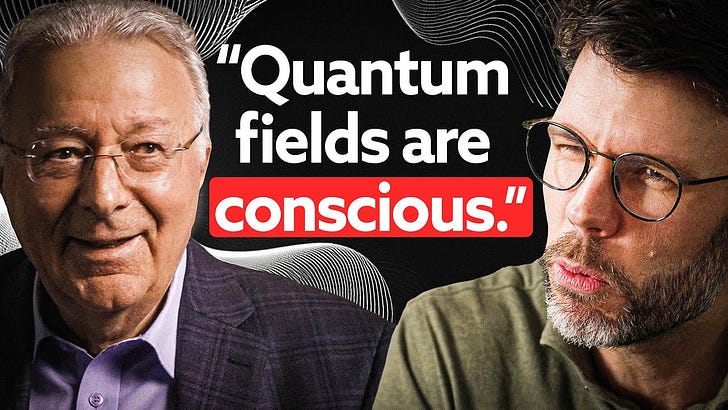
The deepest thing John said, and the thing I think about most, is this: the control structure’s most fundamental lie is that consciousness is produced by the physical. Turn that around, and everything changes. If consciousness creates the physical, if we are energetic co-creators rather than biological accidents, then the immense effort poured into keeping humans small, afraid, and distracted makes complete sense. A population living in fear is a manageable population. A population that knows its own power is ungovernable.
Side note on this topic: I highly recommend to pull on the (amazing) thread represented in the work of Federico Faggin, my readers already know him I believe, and I’m currently reading his second great book – “Irreducible”.
The ontological shock, that first shattering of the worldview you were handed, is the hardest part. John calls it the scary part. A lot of people get stuck there, in what I’d call the black pill, or the “dark night of the soul” phase. But past it is something else entirely: the recognition that the control structure is fragile, that we are far more powerful than we’ve been allowed to believe, and that abundance is the natural state. Scarcity is the manufactured lie.

I left this conversation more convinced than ever that the sovereign individual, the one Bitcoin was always pointing toward, is not primarily a financial project. The financial piece matters enormously, but the full picture is legal literacy, digital privacy, food sovereignty, genuine community, and the internal work of escaping the fear program.
Every person who does that work is one more pixel on the screen shifting toward a different picture.
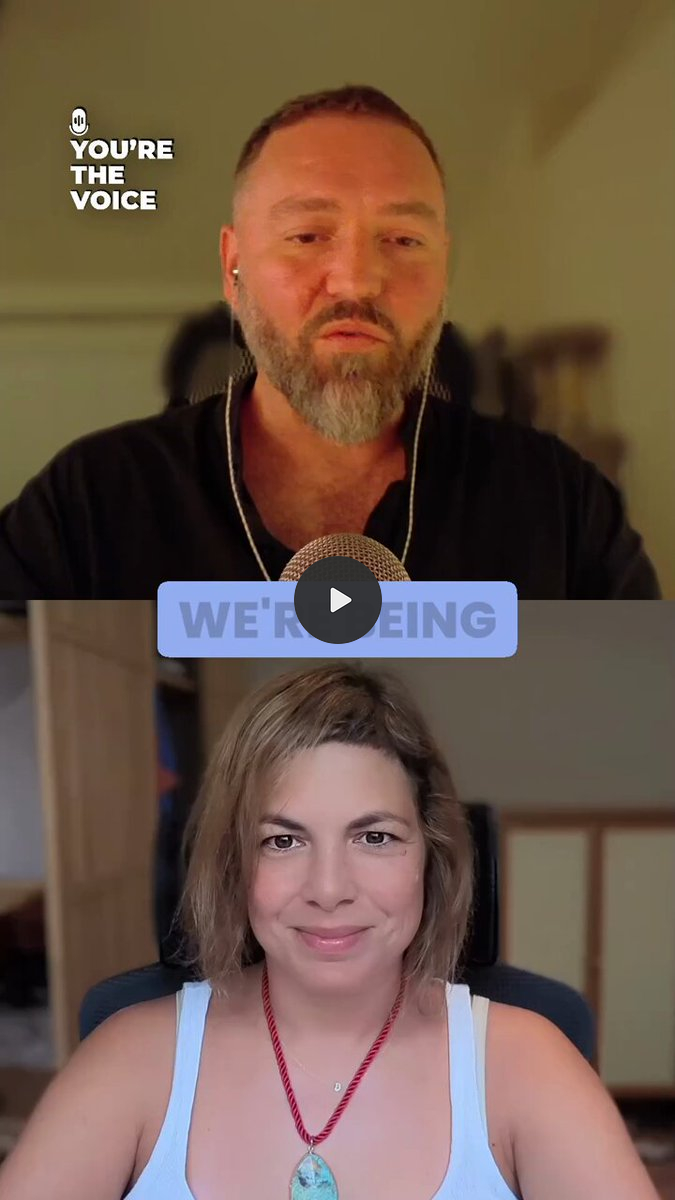
Listen to the full episode with John Burnett on You’re The Voice here.
Follow John:
Twitter | Nostr | Free Digital Privacy Course on X | Free Digital Privacy Course
— Support my work —
I was recently banned from Stripe, so I cannot have paid memberships on Substack… but there’s always another way!
Connect with me:
Twitter | YouTube | Instagram | Nostr | My podcast | All other links
Sponsors:
Camp Nakamoto
→ Join me at Camp Nakamoto, a family-friendly Bitcoin retreat on a private island in New Hampshire, June 18–21. Code EFRAT for 15% off: https://www.campnakamoto.com/
Ledn
→ Access liquidity without selling your Bitcoin with Ledn — learn more at https://ledn.io/Efrat


Trezor
→ Get your TREZOR wallet & accessories, with a 5% discount, using my code at checkout (get my discount code from the episode - yep, you’ll have to watch it)


Abundant Mines
→ Have you tried mining bitcoin? Stack sats directly to your wallet while saving on taxes with Abundant Mines. A month of free hosting for my followers:

Special offers:
→ Join me at Europe’s biggest and most influential Bitcoin event! Enjoy 10% off your BTC Prague using the code EFRAT.

→ Get 10% off on Augmented NAC to detox the Spike protein, using the code: YCXKQDK2, and this link. (Please note, this is not medical advice and you should consult your MD). Watch the episode with Tina below.


→ Be good to your eyes & health, and get the Daylight tablet - a healthier, more human-friendly computer, zero flicker & zero blue light. Use code EFRAT for $25 off: https://bit.ly/Efrat_daylight

→ Watch “New Totalitarian Order” conference with Prof. Mattias Desmet & Efrat - use code EFRAT for 10% off

→ Get a second citizenship and a plan B to relocate to another country with Expat Money, leave your details for a follow up: https://expatmoney.com/efrat

— Support my work —
I was recently banned from Stripe, so I cannot have paid memberships on Substack… but there’s always another way!


