

Simon Dixon is a geopolitical analyst, Bitcoin OG, and entrepreneur, formerly an investment banker. In this conversation, Simon does a deep dive into the real architecture of power shaping our world, unpacking how financial, military, and technological power structures intersect, and why incentives drive global decisions. From his early days in traditional finance to his journey into Bitcoin, Simon shares what he learned about how money is created, how influence is exercised, how power compromises, and why many leaders operate within larger systems they don’t fully control. We explore the difference between reforming the system and exiting it, the role of sovereignty, sovereign wealth and debt, how media and markets shape narratives, and why Simon sees Bitcoin and self-custody as tools for individual sovereignty. This is a wide-ranging discussion about power, truth, responsibility, and the practical paths toward greater independence in a highly controlled, corrupted world.
→ Please like, comment, share & follow — to help me beat the suppressing algo’s. Thank you!
Follow Simon Dixon :
Twitter | Nostr | Simon’s Website
— Support my work —
I was recently banned from Stripe, so I cannot have paid memberships on Substack… but there’s always another way!
Simon's Proof of Weapons Framework for World Control and Powers:
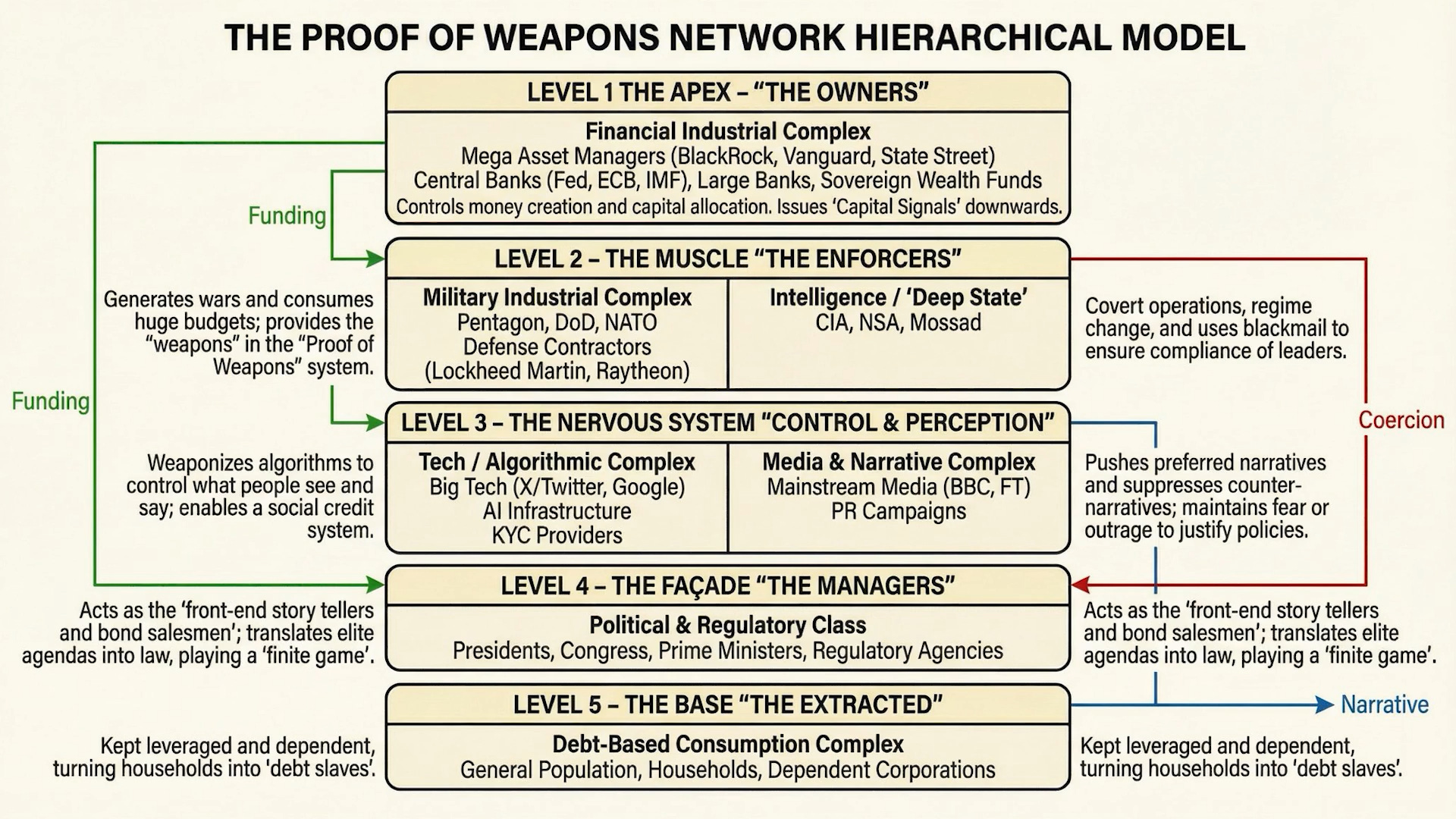
Takeaways:
• His life mission began when his father lost everything in the dot-com crash. That pushed him into a 25+ year pursuit to understand how money really works beyond textbooks and official narratives.
• Working inside stockbroking, market making, and corporate finance convinced him markets run on narratives, incentives, and insider advantage. He argues the public is structurally disadvantaged.
• He lost faith in political reform after seeing bank-influenced financial crisis inquiries. In his view, governments are often subordinate to banking and lobbying interests rather than voters.
• Bitcoin represented an “exit,” not a reform. Fixed supply, self-custody, and permissionless transfer offered a way to step outside the debt system rather than fix it.
• Centralized Bitcoin companies tend to get captured. Regulation, licensing, banking access, and fundraising pull them back into surveillance and control frameworks.
• Holding Bitcoin on a balance sheet helped his company remain independent longer. He sees BTC reserves as protection from VC and banking dependency.
• He rejects the idea of a single secret cabal. Instead, he describes a web of incentives where banks, bond markets, asset managers, and lobbies exert structural power.
• Asset managers gain influence through ownership. Large shareholdings translate into board influence, which shapes executive decisions and corporate direction.
• Debt equals subordination. The more debt a country or company carries, the more it must serve creditors and capital markets.
• Sovereignty exists on a spectrum. Individuals and nations can only become more or less sovereign.
• Countries with strong sovereign wealth and low debt have more negotiating power. They are less vulnerable to external financial pressure.
• He frames war as an economic incentive structure. Conflict is often tied to financial and resource interests, not just ideology.
• Resource-rich regions face external pressure. Countries either align with dominant financial systems or risk currency attacks, instability, or regime change.
• He argues leaders are constrained by larger financial and military structures. Public narratives differ from the global capital dynamics shaping decisions.
• Technology companies now play geopolitical roles. Data, surveillance, and AI platforms function as tools of influence and control.
• Algorithms amplify polarization. Digital platforms push people toward ideological extremes, and division benefits entrenched power structures.
• He sees a shift from a US-centric order toward a multipolar one. Sovereign wealth, resources, and regional financial power matter more than ideology.
• Dollar dominance is under pressure. He views current events as part of a broader monetary and geopolitical transition into a multi-polar world, with the aim of weakening the US dollar and turning the US to a regional power rather than a world empire.
• He describes the Epstein network as part of a broader “compromise” and blackmail system within elite power structures. In his view, association with such networks creates leverage over political, financial, and corporate figures.
• He suggests Epstein-related disclosures function as leverage in power struggles among elites. Being named or exposed can be used as pressure within financial and political hierarchies.
• He links Epstein-connected networks to parts of Wall Street and high finance. He points to overlaps between major financial actors and figures associated with Epstein as an example of how compromise can intersect with capital and influence.
• His practical conclusion is personal sovereignty. Reduce debt, hold assets in self-custody, diversify jurisdictions, and make decisions that steadily increase independence.
Follow me:
Twitter | YouTube | Instagram | My podcast | All other links
Sponsors:
Ledn
→ Access liquidity without selling your Bitcoin with Ledn — learn more at https://ledn.io/Efrat


Trezor
→ Get your TREZOR wallet & accessories, with a 5% discount, using my code at checkout (get my discount code from the episode - yep, you’ll have to watch it)


Abundant Mines
→ Have you tried mining bitcoin? Stack sats directly to your wallet while saving on taxes with Abundant Mines. A month of free hosting for my followers:

Special offers:
→ Join us at the first-ever Women of Bitcoin Summit!

→ Join me at Europe’s biggest and most influential Bitcoin event! Enjoy 10% off your BTC Prague using the promo code EFRAT at checkout.


→ Get 10% off on Augmented NAC to detox the Spike protein, using the code: YCXKQDK2, and this link. (Please note, this is not medical advice and you should consult your MD). Watch the episode with Tina below.


→ Be good to your eyes & health, and get the Daylight tablet - a healthier, more human-friendly computer, zero flicker & zero blue light. Use code EFRAT for $25 off: https://bit.ly/Efrat_daylight

→ Watch “New Totalitarian Order” conference with Prof. Mattias Desmet & Efrat - use code EFRAT for 10% off

→ Get a second citizenship and a plan B to relocate to another country with Expat Money, leave your details for a follow up: https://expatmoney.com/efrat

— Support my work —
I was recently banned from Stripe, so I cannot have paid memberships on Substack… but there’s always another way!


