


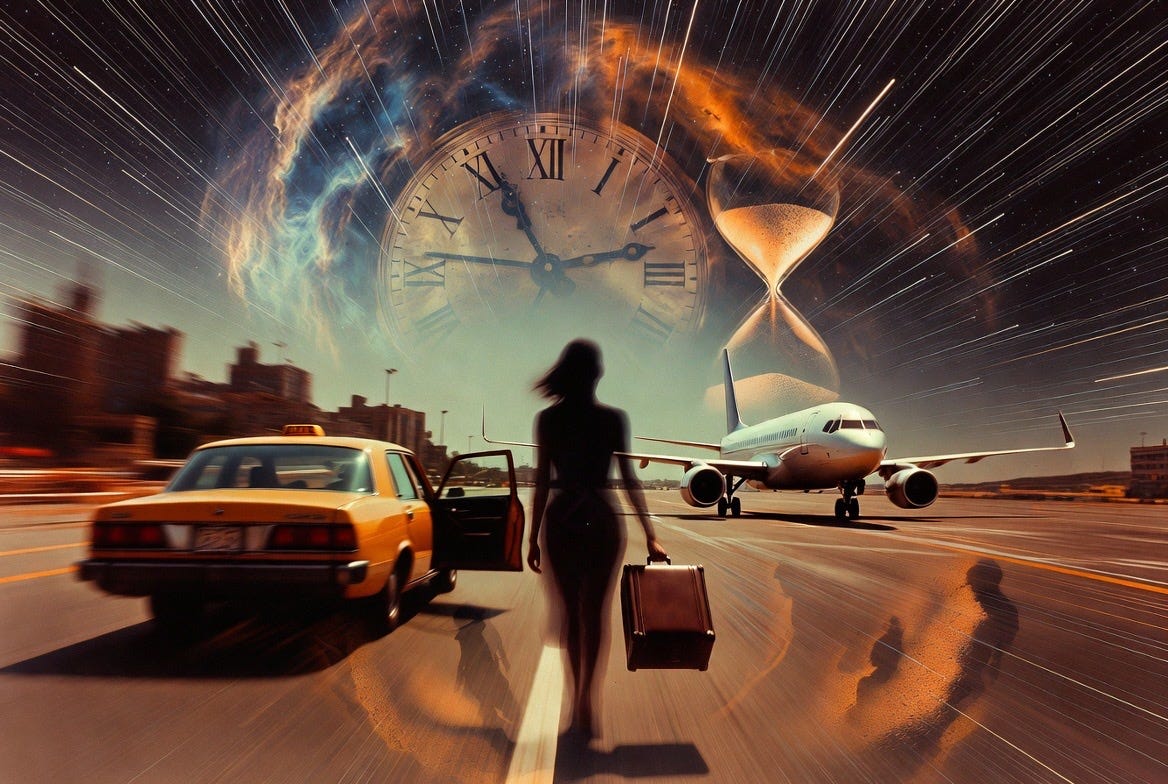
“You’re almost home,” said my Uber driver, as I stepped into his car.
I smiled and said “yes”, but in my heart, I quietly disagreed. I am home. Right now. After long journeys like the one I just completed from Asia to the US, without having a geographic “base” to call home, the knowingness that “I am always home” is slippery.
Listen to this article (read by AI):
That’s the thing about being a digital nomad. My suitcase is a running joke, it’s my portable life. But the truth is deeper than that. I carry my home with me not in luggage, but in myself. In my body, my heart, my sense of presence. Like a turtle. Wherever I go, I’m already there.
The driver meant well. He was being kind. And without knowing it, he gave me a gift — a reminder of how fortunate I am to feel at home everywhere. No countdown. No “almost.” Just here, now, home.
We tend to think of home as a place. A matter of space — somewhere you travel to, somewhere you’re not quite at yet. But what if home is less a location and more a moment? What if being home is a time inquiry, not a space one? You are home right now. Always, right now.
That reframe opened something up in me. And then, layered right on top of it, came the time puzzle.
Time Is Wonkey
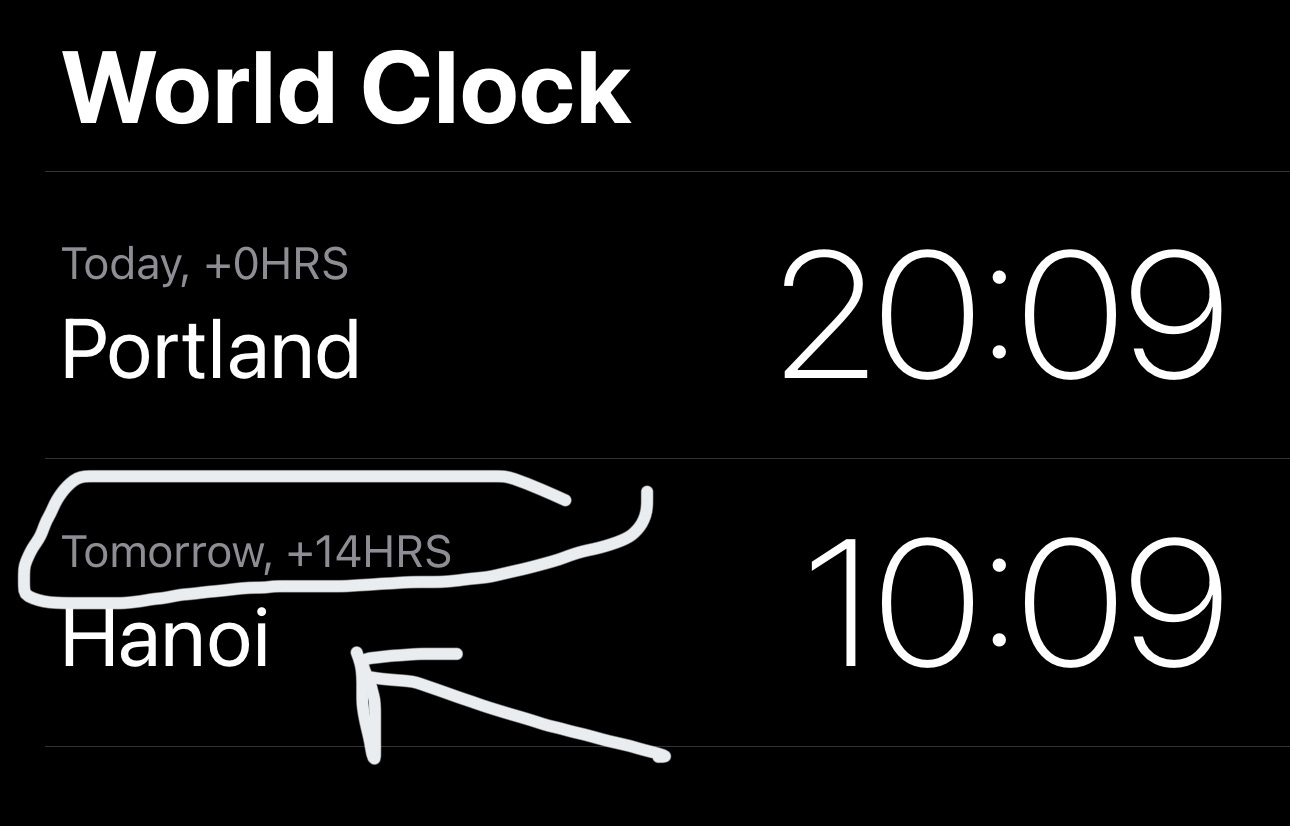
I’d just crossed more than 24 hours of travel. Around the world. I left Vietnam on April 12th in the afternoon, and landed in Oregon on April 12th in the afternoon. Same date. Same general time of day. Different hemisphere, different continent, different everything - except the clock.
I left from the future. Vietnam is 14 hours ahead. I crossed datelines, time zones, and hemispheres, and somehow arrived at the same moment I departed. Different coordinates, same clock.
That made me ponder.
Time, as we relate to it , the way we read clocks, measure hours, structure our days, is a human construct. Yes, it’s anchored in physics. Yes, it follows the laws of this 3D reality we inhabit, synced to circadian rhythms and the rotation of the earth. But the way we symbolize and communicate time? We built that. We agreed on it. And nothing makes that clearer than flying around the globe, watching the hours pass, and landing exactly where you started on the calendar.
Time is weirder than we let ourselves acknowledge.
We take it as fixed. As objective. As fact. But if you’ve ever spent time in a deeply imaginative state: daydreaming, meditating, or disconnecting from 3D reality, you’ve probably felt how elastic it can be. Those who’ve experienced psilocybin know this intimately. Time stretches, collapses, folds. You can feel like you’re in several places at once, and it may feel like a glitch. Quantum physics has been pointing at this for decades. A particle can exist in multiple states simultaneously. “What the Bleep Do We Know?” - that film from the early 2000s, brought this into mainstream conversation before most people were ready for it. Itzhak Bentov talked about it in his work, and Federico Faggin keeps opening my head to it.
We live as if time is a straight line. But maybe it’s more of a field.
Adopt A Different Lens on Time
Travel is one of the best tools I know for noticing the invisible structures you live inside, and time is one of them. When you’re constantly crossing time zones, adjusting your sleep, resetting your rhythm, you stop relating to the clock as something fixed and start relating to it as something you negotiate with. The structure becomes visible precisely because you keep disrupting it.
And that structure does have real value. Linear time: calendars, schedules, shared reference points, is genuinely useful. It helps us coordinate, plan, show up for each other. Being a good timekeeper isn’t something to dismiss. When you’re in tune with time, life flows more easily. That’s real.
But being in tune with something is different from being imprisoned by it. Questioning a system means understanding it well enough to use it consciously, despite the initial urge to abandon it. The same way I think about money, identity, and every other structure we’ve inherited: know the rules, know who made them, and decide for yourself how much authority they have over you. Time deserves the same scrutiny. Try experiencing it differently; through stillness, through travel, through whatever loosens the grip of the default setting.
And You?
Lately, my experience of time has been genuinely strange. Over the last few years, I feel everything accelerating... so much happening in a single day that time just flies. And then I look back at the last six years and it feels like two decades. One year feels like ten. The compression and the expansion seem to be happening simultaneously, and I don’t think I’m alone in that.
I’m curious where you are with this. How do you experience time right now, and has that changed?
Please take a moment to like, comment and share.
♥️ Efrat
* This is also an X/Twitter & Nostr - share there!
Connect with me:
Twitter | YouTube | Instagram | Nostr | Podcast | All other links
Latest releases:






Sponsors:
Camp Nakamoto
→ Join me at Camp Nakamoto, a family-friendly Bitcoin retreat on a private island in New Hampshire, June 18–21. Code EFRAT for 15% off: https://www.campnakamoto.com/

Ledn
→ Access liquidity without selling your Bitcoin with Ledn — learn more at https://ledn.io/Efrat


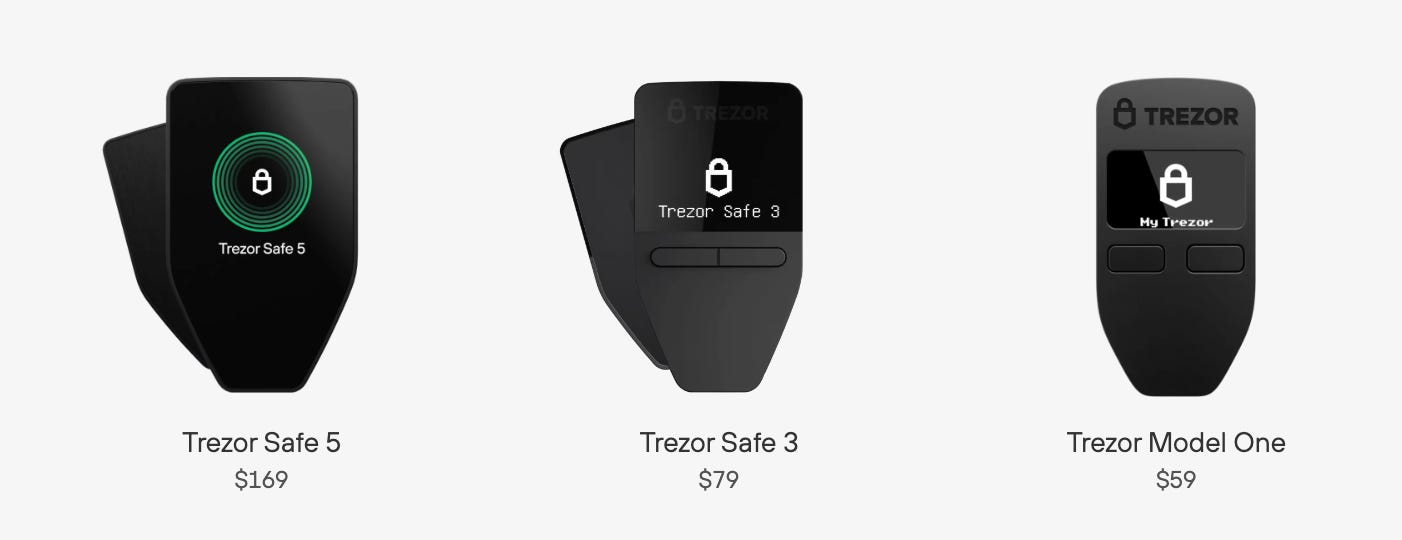
Trezor
→ Get your TREZOR bitcoin wallet & accessories, with a 5% discount, using my code at checkout (get my discount code from the episode - yep, you’ll have to watch it)

Abundant Mines
→ Have you tried mining bitcoin? Stack sats directly to your wallet while saving on taxes with Abundant Mines. A month of free hosting for my followers:

Special offers:
→ Join me at Europe’s biggest and most influential Bitcoin event! Enjoy 10% off your BTC Prague using the code EFRAT.
→ Get 10% off on Augmented NAC to detox the Spike protein, using the code: YCXKQDK2, and this link. (Please note, this is not medical advice and you should consult your MD). Watch the episode with Tina below.


→ Be good to your eyes & health, and get the Daylight tablet - a healthier, more human-friendly computer, zero flicker & zero blue light. Use code EFRAT for $25 off: https://bit.ly/Efrat_daylight

→ Watch “New Totalitarian Order” conference with Prof. Mattias Desmet & Efrat - use code EFRAT for 10% off

→ Get a second citizenship and a plan B to relocate to another country with Expat Money, leave your details for a follow up: https://expatmoney.com/efrat

— Support my work —
I was recently banned from Stripe, so I cannot have paid memberships on Substack… but there’s always another way!
.
Welcome to Oregon and Portland, your home for now.
"But what if home is less a location and more a moment?
What if being home is a time inquiry, not a space one?
You are home right now.
Always, right now."
In 1985 I visited Portland, flying there from Chicago. Upon our descent, the Pilot announced that when we arrive it will be 1959 (pilots are trained in military time). After seeing the city for a few days, I tended to more closely align with the pilot's offering of a date stamp vs. a time stamp.
To me, Home is a dream lived in, as you call it, a "meat suit" worn for a specific period of time.
It for many could also be a hope, a feeling, an emotional experience, a social construct.
And for many, home is where your heart is.
Dinosaurs roamed the Earth for approximately 165 million years, appearing around 230 to 251 million years ago and going extinct about 66 million years ago. In stark contrast, modern humans (Homo sapiens) have existed for only about 200,000 to 300,000 years, making the dinosaur reign roughly 550 times longer than human existence.
If one chooses to look at the 'timing' of human history, it is (relatively speaking) short, complex and not always 'pretty' (might explain how Dinosaurs lived so long).
Even Oregon has one.
Oregon, a state of 96,000 square miles with 3 distinct climates (costal, marine interior, and high desert plateau (it can snow as late as April).
Included in its history is the glacial carving of the Columbia River basin from 15 to 20k years ago, allowing one to witness cascading waterfalls careening off the sides of massive cliffs, like the over 600 foot high Multnomah Falls, the most visited tourist attraction in Oregon, right along Hwy I-84, as one heads east out of Portland towards Bonneville Dam.
Oregon's researched and recorded history spans over 15,000 years, beginning with Paleo-Indians who inhabited the region, with the earliest physical evidence found at Fort Rock Cave dating back 13,200 years.
By 8000 B.C., settlements were established throughout the state, particularly along the Columbia River and coastal areas, home to diverse Native American groups like the Chinook, Klamath, and Nez Perce.
European exploration began in the 16th century, with Spanish ships reaching the coast and British fur traders, notably from the Hudson's Bay Company, establishing Fort Vancouver in 1825 as a regional hub.
Oregon Territory was officially formed in 1848, and after years of settlement encouraged by the Donation Land Claim Act, Oregon became the 33rd state on February 14, 1859 (Valentine's Day, the irony).
Oregon's history, unfortunately attracted dark clouds overhead, especially as it pertained to people of color, which was defined by systematic exclusion and resilience, as the region was explicitly designed as a "white utopian homeland."
Before statehood in 1859, the provisional government passed the "Lash Law," which mandated that free Black people be publicly whipped every six months until they left the territory, a punishment later replaced by forced labor.
Oregon became the only state admitted to the Union with a constitutional clause prohibiting Black people from living, working, or owning property, a ban that remained in effect until 1926.
Asian and Hawaiian (Kanaka) residents also faced severe discrimination, including a $5 tax and forced labor requirements, while Native American communities were displaced (aka: genocided) from their lands to make way for white settlers.
Moving to "Time" as a construct,
"Those who’ve experienced psilocybin know this intimately. Time stretches, collapses, folds.
You can feel like you’re in several places at once, and it may feel like a glitch."
It's been well rumored, to the point of almost certain truth, that the use of psybicilin (LSD/microdosing/adderall/etc.) was part of the evolution of binary code technology, freeing the mind to turn off the 'noise of life' and laser focus on the problem solving issue in front of them.
Your comment:
"Lately, my experience of time has been genuinely strange. Over the last few years, I feel everything accelerating... so much happening in a single day that time just flies. And then I look back at the last six years and it feels like two decades. One year feels like ten. The compression and the expansion seem to be happening simultaneously, and I don’t think I’m alone in that."
To me, you represent a sort of "corsair", a traveling deliverer of hope, truth, integrity, pursuit of sovereignty and personal growth.
It's only going faster in my opinion, because you're picking the speed at which you travel, as well as the pace which you choose to take in and absorb your surroundings.
Enjoying your meditative moments in Bali and those forever hugs given to you by your son during time spent together, potentially could have almost stopped time completely.
For this short time that we're here, I'd say you're right at home, right here at: "YOU'RE THE VOICE".
Thanks for making that your home.
A place we can visit, like hanging out in the kitchen of Grandma's house, where everything is going to be intelligent, therapeutic, upbeat and comforting (and sometimes discomforting for good reason).
PS: Since music sometimes catches your attention, here's the official audio version of Chicago Transit Authority's "Does Anyone Really Know What Time It Is?" released well before you were even a baby, 1969.
https://www.youtube.com/watch?v=9FzCWLOHUes&list=RD9FzCWLOHUes&start_radio=1
Blessings
This is SO good, Efrat! You always make me think deeper. Whether it’s in an interview with a guest or in an article like this. I was at Bitcoin Park in Nashville 2 weeks ago, heading to the Vegas Bitcoin conference in 2 weeks and am literally sitting on the ferry back from Isla Mujeres, MX after a week down here as I write this, so I can relate to everything you explained here. You are spot on and I am going to make a conscious effort to adopt this perspective in my daily life! 🙏🧡