


This is my fourth visit to El Salvador in the last few years. I came this time to speak at Bitcoin Histórico and at the Bitcoin Circular Economies Summit in El Zonte. Every time I come back, I find more depth in the human story behind this country’s transformation. I talk to locals and listen for how the change has touched their lives. This time, I left with the stories of people who got their lives back.
In one day, I taught a class to the next generation of Salvadoran builders and entrepreneurs, then visited three towns once ruled by gangs: Panchimalco, Apopa and San Juan Opico. Each now has a CUBO community center with a Bitcoin Zone inside. Bitcoin was my way in, but the people became the story.
From Breakdowns to Breakthroughs
The day started with a two-hour class for the students of CUBO+ and CUBO_AI, called “From Breakdowns to Breakthroughs.” I shared my story, from a computer science student to a second career in journalism and media I never planned. My life looks a lot like the Bitcoin chart: a rollercoaster with an upward trend, where every low is followed by a new high. The lesson I left them with: after every crisis, take the time to grieve it, integrate it, identify the lesson, and keep moving. Trust yourself, you’ll figure it out.
I didn’t know yet that I’d spend the rest of the day meeting a whole country living that lesson.


Inside the CUBOs
After the class, we hit the road. CUBOs (Centros Urbanos de Bienestar y Oportunidades, urban centers for wellbeing and opportunity) are community centers built in neighborhoods that were once ruled by gangs.

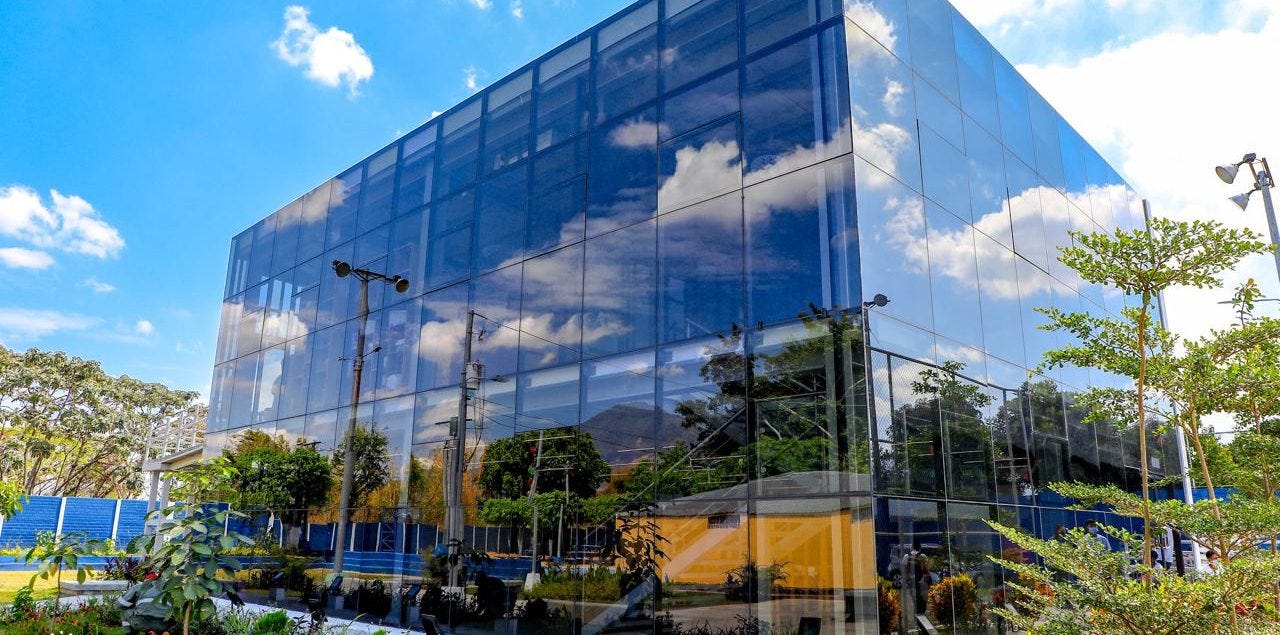
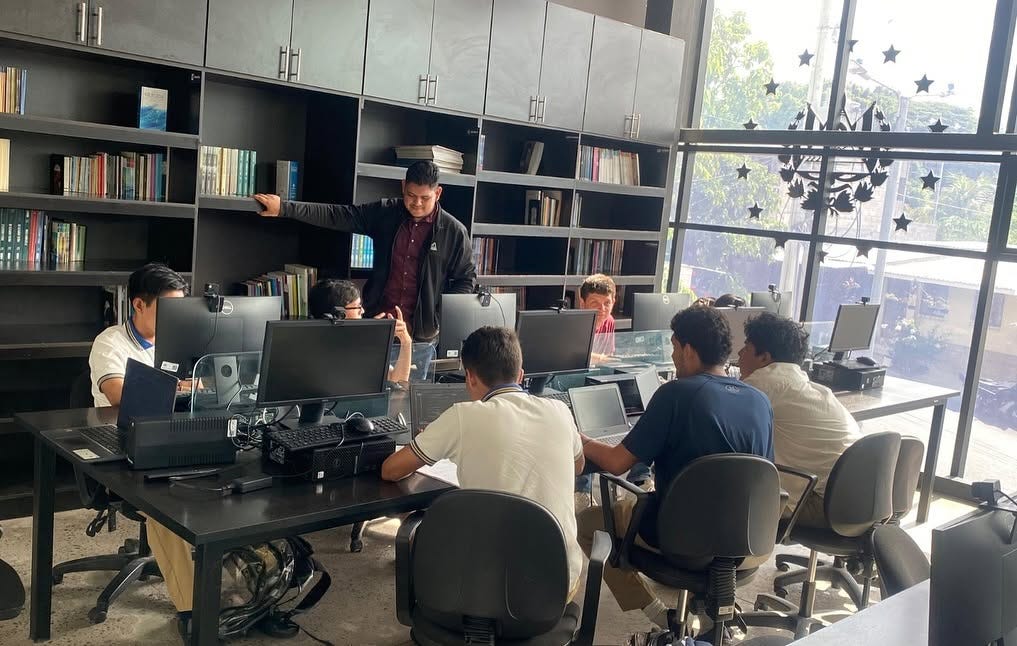
Every CUBO has books, a large computer area and video game consoles. My favorite rule: kids can play only after reading a book for at least 15 minutes.
Inside some CUBOs you’ll find a “Bitcoin Zone”. It’s a joint effort of the National Bitcoin Office and the Dirección de Reconstrucción del Tejido Social, the government body rebuilding the country’s social fabric. Each zone has books on Bitcoin and economics in Spanish and English, staff trained in Bitcoin and financial literacy, and a path for young people into CUBO+ and CUBO_AI.
What’s unique in El Salvador, in my eyes, is the direction of power. The country is removing the red tape around financial education. Young children learn what money is and what Bitcoin is. Teens learn to set up their own Bitcoin nodes. Bitcoin can give people financial freedom and loosen the grip of control that comes through money, setting the next generation up for a freer, more sovereign life.
That’s sovereignty pushed in the direction of the people, while almost everywhere else in the world, those at the top don’t release control; they tighten it.
Panchimalco: A Blank Canvas
In 2015, during one of the deadliest periods in El Salvador’s history, Panchimalco was a gang battleground. Families lived in constant fear, and kids grew up with few options.
In February 2026, it became home to the country’s third Bitcoin Zone. Today those same kids have books, technology and an education in Bitcoin and the future of money. The CUBO staff are trained in financial literacy and Bitcoin, ready to share it with the whole community, from kids to grandparents.
Here I met Juan, who leads Casa Bitcoin, digital literacy and Bitcoin education for seniors in El Salvador. I also met representatives of the local artisan community, who make handwoven textiles, scarves, ceramics, pottery and artwork, all with traditional techniques.
Their creations fill the big B, the bookshelf at the heart of every Bitcoin Zone. And here’s a fun fact I discovered: every B across the country starts out white, on purpose. It’s a blank canvas, so each community can fill it with its own creations, colors, character and soul. In Panchimalco, the B holds their handmade vases, pottery and textiles.


Before leaving, I bought a handcrafted bag. I paid in Bitcoin over Lightning, straight to the young girl and her mom who made it. You see, in most places around the world, a transaction like that, “peer-to-peer electronic cash,” is still considered sci-fi, misunderstood or simply forbidden. Here, it’s a reality.


Growing Together, Growing with Love
In Panchimalco I also discovered two programs that moved me deeply: Crecer Juntos (Growing Together) and Creciendo con Amor (Growing with Love). They’re part of the early childhood work led by First Lady Gabriela de Bukele. They support young mothers, single mothers, teen mothers and pregnant women, and accompany children from pregnancy to age 8.
Two young women from the CUBO staff told me the area has a very high share of young, single and teen mothers, a legacy of the gang war. Many girls became mothers very young. So I asked them: do these women feel comfortable coming to the CUBO, or are they embarrassed?
They said it’s common in El Salvador, especially in the areas that suffered most, so there’s little shame. The mothers come for guidance: basic parenting skills, caring for their bodies during pregnancy, and community. The name of the game here is support. Becoming a mother young, with everything your body goes through, can feel strange and overwhelming. I know, I’m a mother too. Having this support in place is a real blessing.
Apopa: The Invisible Borders
Our second stop was Apopa, once one of the most dangerous places in El Salvador.
The gangs ruled these neighborhoods with invisible borders. They used the speed bumps on the roads to mark where those borders were. Cross one, and you could be beaten or killed.
One story stayed with me: the gangs drew a border right outside a school. Kids whose homes were a few minutes’ walk across the road had to circle the whole town, for hours, to get home, because crossing meant risking their lives.
There was also a gang curfew. Everyone had to be home by 6 p.m., every evening. If you weren’t, you risked your life.
The small homes I saw in Apopa, and in most of the neighborhoods I visited, are still fully gated, with barbed wire on the roofs and fronts. It’s a reminder of how families tried to keep gang members from climbing in to kidnap, abuse or kill.
In 2026, this community became home to a Bitcoin Zone at CUBO Valle Verde.
Free Like Butterflies
And what a welcome. Four kids waited at the entrance with drums. Inside, a dozen elderly ladies were in an art class with their teacher, Lupita, drawing and coloring, with beautiful smiles and glowing faces. I had to stop and talk with them.
They told me they feel free now, like butterflies, like birds. They’re no longer bound by the gangs’ violent rules. They got their lives and their liberty back. They love coming to the CUBO to meet friends, create, talk, laugh and have fun together, something they never had before. And there’s no more 6 p.m. curfew. They can stay as long as they want.
I asked how they feel about the country, the government and Bukele. They said they love him and are so grateful for their new lives. We hugged, and I went on my way.


After I shared the moment on Instagram, Lupita wrote to me:
“These women have so many stories, so much wisdom, and so much love to share. Thank you for seeing with such kindness the beautiful things that happen in this space. At CUBO Valle Verde, there are always hearts ready to learn, share, and bloom! 🇸🇻🌷”
I’ll remember them forever.
The team showed me photos from before, during and after the construction. They’re deeply proud of this place, with daily activities for kids, adults and families.
Here, the community arranged the big B their own way. Next to it, a mempool dashboard shows El Salvador’s Bitcoin reserve growing, alongside CUBO students’ certificates verified on the blockchain.
Apopa had a special energy: the energy of a free community.


San Juan Opico: The Engineer’s House
Our last stop was the most moving one.
The CUBO in San Juan Opico carries the name of Engineer Rigoberto Arnulfo Orellana Canales. He was a young man from this neighborhood who earned his mechanical engineering degree on a scholarship, led the youth at his parish, and tutored local kids in math and English. He dreamed of seeing El Salvador prosper, with beautiful buildings to house the talent of the next generation.
In 2019, at 26, he was shot while waiting in line at a local clinic. The whole country knew his story. The CUBO opened in his name in 2021, and in October 2026 it became home to a Bitcoin Zone.
We arrived around 7 p.m., and the CUBO was bursting with life. Outside, a band of young teenagers was rehearsing on all kinds of instruments. Inside, young girls were practicing ballet. Families with little kids sat next to the Bitcoin Zone in an English class. Upstairs, a group was learning guitar. There was a daycare area and a warm room for Crecer Juntos and Creciendo con Amor, for parents and their babies. And of course, every computer and console was taken.


Jimmy, who leads the CUBO, told me it has welcomed more than 100,000 visits since it opened. Remember the 6 p.m. gang curfew in Apopa? Here, after dark, people are fully into life.
Don Tito
Here I met a very special man: Don Tito Orellana, Rigoberto’s father. He comes to the CUBO often, as a regular and a guest of honor. This is where he sees his son’s spirit alive. This is what Rigoberto wanted, and seeing his vision come to life means everything to him.
We spoke through a translator, and we both cried. It’s hard to talk about a son who was murdered, but it was also a beautiful conversation with a man who cares deeply.
He told me his son’s death means two things to him: Rigoberto is a martyr, and his death leaves a question: do we really need to go through so much pain to learn, and to build life again?
At his son’s funeral in 2019, Don Tito asked the congregation to repeat the words attributed to Saint Óscar Romero: “If they kill me, I will rise again in the Salvadoran people.” For him, this CUBO is where that happens.
A book about Rigoberto’s legacy, “El Ingeniero” (”The Engineer”), sits in the CUBO. Don Tito signed a copy for me:
“Dear Efrat, I hope many people learn about my son, the engineer Rigoberto’s legacy.”
That’s why I’m sharing his story.


When we stepped back outside, young people were breakdancing under the lights to hip hop music. Rigoberto’s vision is alive in San Juan Opico.
Fully Into Life
Throughout my visit on that special day, I heard the same story in different voices: people feel liberated, supported, part of a community, happy, free, and fully engaged in life.
We humans love duality. In the global conversation, people judge El Salvador and its Bitcoin adoption as if they were one monolithic thing. This mindset has us looking for deterministic answers and putting things in boxes: good or bad, for or against. But life is complex and nuanced, and human stories matter.
El Salvador is not perfect. Bukele is not perfect. But he’s a bold leader transforming a country of 6.5 million people, and the process is never clean or smooth.
What I see every time I visit is a country in the process of “low time preference” construction, step by step. New foundations, built on a consciousness that chooses growth and sovereignty over fear. It’s a long process, and it’s worth the wait.
Places once defined by violence are now giving the next generation the tools to build their future.
— End

Recent articles:


Connect with me:
Twitter | YouTube | Instagram | Nostr | LinkedIn | My podcast | All other links
Sponsors:
Ledn
→ Access liquidity without selling your Bitcoin, get 0.25% off your first loan: https://ledn.io/Efrat


Trezor
→ Get your TREZOR wallet & accessories, with a 5% discount, using my code at checkout (get my discount code from the episode - yep, you’ll have to watch it)

Abundant Mines
→ Have you tried mining bitcoin? Stack sats directly to your wallet while saving on taxes with Abundant Mines. A month of free hosting for my followers:


Special offers:
→ Want to preserve your privacy online? Get a GrapheneOS privacy phone or laptop, up to $150 off “Above Phone” products + extra $50 off with code EFRAT: https://abovephone.com/efrat/

→ Get 15% off “Born To Be Free” all-natural, tallow-based skincare products on a bitcoin standard, using code EFRAT: https://oshi.link/1nvZYq


→ Join me at any of these conferences or events:

→ Get 10% off on Augmented NAC to detox the Spike protein, using the code: YCXKQDK2, and this link. (Please note, this is not medical advice and you should consult your MD). Watch the episode with Tina below.


→ Watch “New Totalitarian Order” conference with Prof. Mattias Desmet & Efrat - use code EFRAT for 10% off

— Support my work —
I was recently banned from Stripe, so I cannot have paid memberships on Substack… but there’s always another way!